
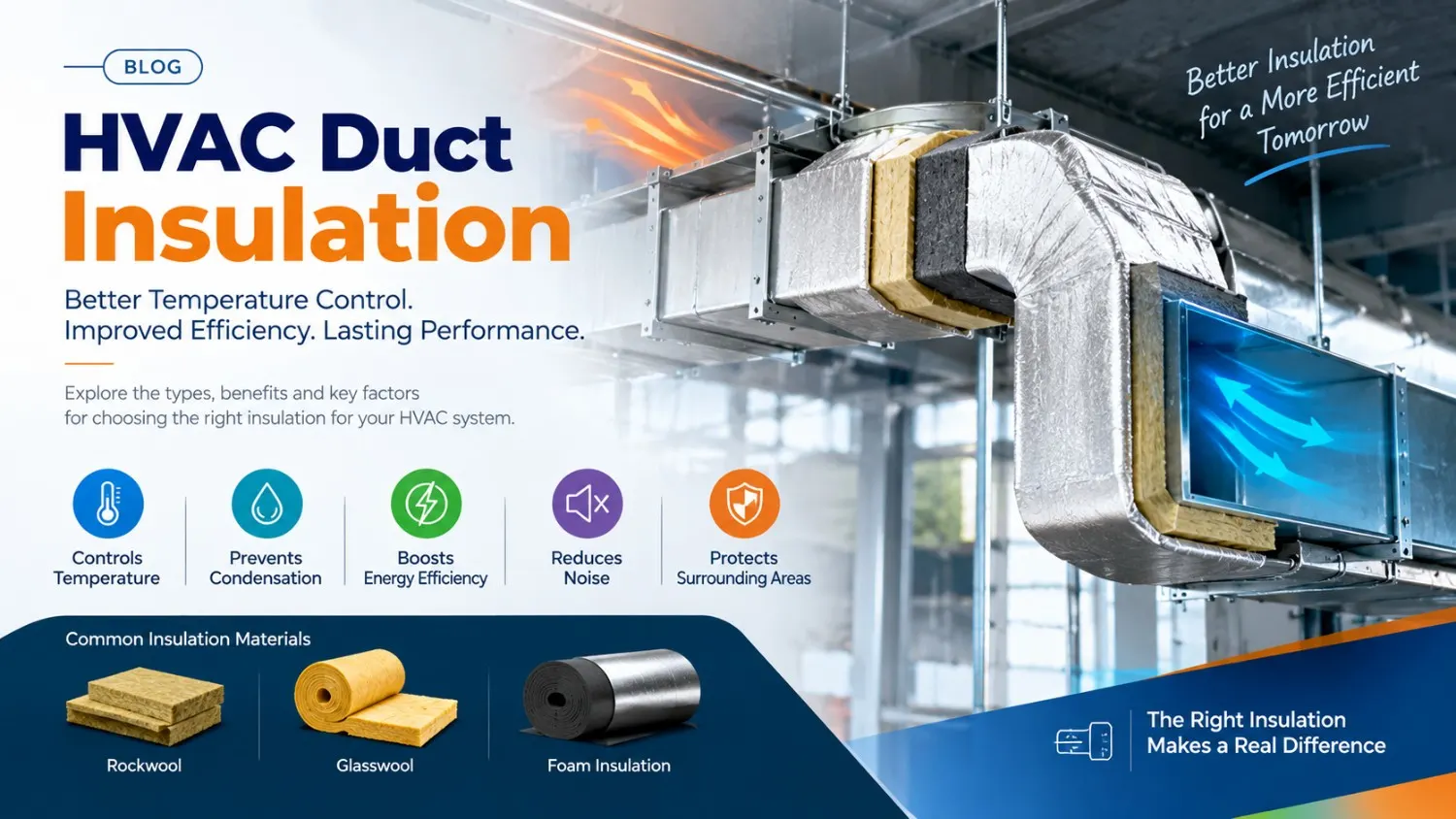
HVAC duct insulation plays an important role in maintaining air temperature, controlling condensation and supporting the efficient operation of heating, ventilation and air conditioning systems. In factories, warehouses, hospitals, commercial buildings and other industrial facilities, ductwork often passes through areas with different temperatures and environmental conditions. Without suitable insulation, heat transfer through duct walls can affect the temperature of the air being distributed and increase the demand on HVAC equipment.
Selecting the right HVAC duct insulation requires careful consideration of the operating temperature, moisture exposure, duct location, fire safety requirements and intended application. Materials such as mineral wool, glasswool and flexible foam insulation have different properties, making it important to match the material to the requirements of the system.
This guide explains the main types of HVAC duct insulation, their benefits, common industrial and commercial applications, and the factors to consider when choosing insulation materials for new installations or existing ductwork.
What Is HVAC Duct Insulation?
HVAC duct insulation is a layer of insulating material applied to air ducts to reduce unwanted heat transfer between the air inside the duct and the surrounding environment. Depending on the material and system design, duct insulation can also help manage condensation and reduce certain types of noise transmission.
During cooling, conditioned air travels through ducts towards different rooms or production areas. If the duct passes through a hot roof space, an unconditioned service area or a warm plant room, heat can enter the duct and raise the air temperature. During heating, the opposite can happen as heat escapes from the duct into colder surroundings. Properly selected insulation reduces this heat exchange and helps the HVAC system maintain the required air conditions.
In chilled-air applications, the outside of a duct can become cold enough for moisture in the surrounding air to condense. A correctly designed insulation system helps keep the external surface temperature under control. Where required, a continuous vapour barrier and properly sealed joints help prevent moisture from entering the insulation.
An HVAC duct insulation system may include mineral fibre or foam insulation, suitable adhesives or mechanical fasteners, a vapour-control layer where needed, and external cladding where protection against weather, impact or other site conditions is required. Each component must be suitable for the operating environment.
Key Benefits of HVAC Duct Insulation
1. Reduces unwanted heat gain and heat loss
Uninsulated ducts can exchange heat with their surroundings as conditioned air moves through the system. Insulation adds thermal resistance, helping reduce heat gain in cooling applications and heat loss in heating applications. This is particularly useful where ducts pass through roofs, plant rooms, service shafts and other spaces that are not maintained at the same temperature as the occupied area.
2. Supports HVAC energy efficiency
Reducing unwanted heat transfer can help an HVAC system maintain its required supply-air temperature with less additional heating or cooling. The actual energy savings depend on duct length, operating hours, surrounding temperature, insulation thickness, system design and equipment efficiency. Insulation should therefore be selected as part of the complete HVAC system rather than on the basis of material cost alone.
3. Helps manage condensation
Condensation can develop when a surface temperature falls below the dew point of the surrounding air. In chilled-air ductwork, inadequate insulation, damaged vapour barriers or gaps around joints can allow moisture to accumulate. A suitable insulation material, correctly designed vapour control and continuous installation help reduce this risk. Moisture protection is particularly important in humid areas and locations where damp insulation could damage nearby equipment or building finishes.
4. Can contribute to noise control
Some duct insulation materials absorb sound or help limit sound transmission through duct walls. This can be beneficial in offices, hospitals, commercial buildings and selected industrial environments. However, thermal insulation does not automatically eliminate HVAC noise. Fan noise, turbulent airflow, vibration and sound travelling through the duct interior may require separate acoustic treatment or vibration-control measures.
5. Helps protect surrounding building components
When condensation is managed effectively, insulation can help reduce the risk of moisture-related staining, corrosion of susceptible components and damage to nearby ceilings or finishes. The insulation and any external covering must be appropriate for the environment, and damaged sections should be inspected and repaired to maintain system performance.
Types of HVAC Duct Insulation Materials
Several insulation materials are used for HVAC ductwork. The most appropriate option depends on thermal performance, temperature limits, moisture conditions, fire requirements, acoustic needs and the method of installation. The following materials are commonly considered for different duct insulation applications.
1. Rockwool Insulation
Rockwool, also known as stone wool or mineral wool, is manufactured from mineral-based raw materials and is available in different product forms, including slabs, rolls and mats. It is used in a range of industrial and building insulation applications because suitable grades can provide thermal resistance and fire performance.
For HVAC ductwork, the selected Rockwool product must be appropriate for the duct surface, operating temperature and installation arrangement. Density, thickness, facing, fixing method and external protection should be chosen according to the project specification. Not every Rockwool product is intended for the same application, so the product's technical data should be checked before selection.
Rockwool may be considered for industrial facilities, plant rooms and other installations where thermal insulation and fire-related performance are important. Explore the available Rockwool insulation products to understand the product options relevant to insulation requirements.
2. Glasswool Insulation
Glasswool is a fibrous insulation material made from glass fibres. It is available in forms such as rolls, blankets and boards, depending on the intended application. Its relatively lightweight structure can make suitable products practical for insulating HVAC ducts in commercial buildings and industrial facilities.
Glasswool is commonly considered for thermal insulation and, where the product is designed for it, acoustic absorption. Its performance depends on the specified thickness, density, facing and installation quality. The material must be protected from moisture exposure in accordance with the system design, and joints should be finished correctly to reduce gaps in the insulation layer.
Glasswool may be suitable for ductwork in offices, commercial premises, service areas and selected industrial installations. Review the available glasswool insulation materials and confirm that the chosen product meets the project's thermal, acoustic and fire-performance requirements.
Other Types of HVAC Duct Insulation Materials
Rockwool and glasswool are widely used for thermal and acoustic insulation, but they are not the only options available for HVAC ductwork. Depending on the operating temperature, moisture exposure, installation space and project requirements, foam-based insulation and protective cladding may also be considered. The correct choice depends on the complete duct system rather than the insulation material alone.
3. Elastomeric Foam and Nitrile Rubber Insulation
Elastomeric foam insulation is a flexible, closed-cell material commonly used in air conditioning and refrigeration applications. Its structure helps restrict moisture movement through the insulation when the material is correctly selected, installed and sealed. This makes it useful for ductwork and associated HVAC components where condensation control is an important consideration.
Nitrile rubber insulation is commonly supplied in flexible sheet or tube forms, depending on the intended application. For duct surfaces, suitable sheet insulation can be selected according to the system design, surface temperature and required insulation thickness. Joints, edges and penetrations need careful sealing because gaps can allow humid air to reach cold surfaces.
Elastomeric insulation may be suitable for selected commercial HVAC systems, air conditioning installations and applications involving chilled air. However, its temperature limits, fire performance, smoke characteristics and compatibility with the installation environment should always be checked against the manufacturer's technical documentation and applicable project specifications.
For projects where flexible rubber-based insulation is being evaluated, nitrile foam sheet is one product category to consider when assessing material suitability.
4. XLPE Foam Insulation
Cross-linked polyethylene (XLPE) foam is a lightweight foam insulation material used in selected thermal insulation applications. Its closed-cell structure can provide resistance to moisture absorption under suitable conditions, while its relatively low weight can make handling and installation easier.
XLPE foam may be considered for specific HVAC or building-service applications where its temperature range, thickness, fire characteristics and physical properties meet the design requirements. It should not automatically be treated as a replacement for mineral wool or glasswool. Each material has different performance characteristics, and industrial projects may have requirements that favour one type over another.
Before choosing XLPE foam for duct insulation, confirm that the proposed product is approved for the intended use and that it meets applicable fire and smoke requirements. The insulation must also be compatible with the duct surface and any required protective finish. Suitable XLPE foam insulation products can be reviewed as part of this material-selection process.
5. Protective Cladding for HVAC Duct Insulation
Insulation and protective cladding perform different functions. The insulation layer helps reduce heat transfer, while the external cladding protects the insulation against physical damage, weather exposure and other site-specific conditions. A suitable cladding system can also provide a finished external surface where the ductwork is visible or installed in an industrial environment.
Aluminium cladding may be used in suitable applications because it is lightweight and can provide an external protective covering when correctly detailed and installed. The required sheet thickness, joint arrangement, fixing method and weather protection depend on the installation location and project specification.
For relevant industrial applications, aluminium cladding sheets may be assessed as part of the overall insulation protection system. Cladding selection should account for access requirements, corrosion exposure, mechanical impact and the possibility of water entering through poorly sealed joints.
Applications of HVAC Duct Insulation
HVAC duct insulation is used across many types of buildings and industrial facilities. The purpose and required insulation specification can vary considerably depending on whether the system handles cooled air, heated air, fresh air or conditioned air for a temperature-sensitive environment.
Industrial Plants and Manufacturing Units
Manufacturing facilities often contain extensive duct networks connecting air handling units, production areas, ventilation systems and other building services. Insulation helps control unwanted heat transfer as air moves through these networks. In suitable applications, it can also reduce the risk of condensation on cold duct surfaces and help manage noise from airflow.
Industrial sites may expose ductwork to dust, vibration, maintenance activity and accidental impact. Material selection should therefore consider not only thermal performance but also the need for a protective outer layer. Insulation thickness, joint sealing and access to dampers or inspection points should be coordinated with the overall installation plan.
Commercial Buildings and Office Spaces
Offices, shopping complexes, hotels and other commercial buildings use ductwork to distribute conditioned air across multiple rooms and floors. Where ducts pass through unconditioned areas, ceilings or service shafts, heat gain or heat loss can affect the temperature of the air reaching occupied spaces.
Appropriate insulation can help maintain the intended air temperature and support efficient HVAC operation. Acoustic requirements may also influence the choice of material, particularly where ductwork is close to meeting rooms, workstations or other noise-sensitive spaces. The insulation specification should be aligned with the building design and the requirements of the HVAC contractor.
Hospitals, Laboratories and Controlled Environments
Hospitals, laboratories and other controlled environments may require close management of indoor temperature, humidity, ventilation and air distribution. Duct insulation can help limit unwanted thermal changes and manage condensation risks where cold duct surfaces encounter humid surrounding air.
These facilities can have additional requirements relating to fire safety, hygiene, cleanability and system maintenance. Insulation materials and their external finishes should be selected according to the relevant design criteria rather than on thermal performance alone. Any project-specific standards and approvals must be confirmed before procurement and installation.
Warehouses and Distribution Facilities
Warehouses and distribution centres may have long duct runs, large roof spaces and areas with significant differences between indoor and outdoor temperatures. Insulation can help reduce heat transfer through ducts routed across these spaces, supporting the intended performance of the air distribution system.
Where ducts are installed at height or near storage and material-handling areas, mechanical protection and safe maintenance access also deserve attention. The insulation and its outer covering should be suitable for the environmental conditions and potential physical exposure at the site.
Outdoor Ductwork and Roof-Level Installations
Ductwork installed outdoors or on rooftops can experience direct sunlight, rain, wind and changing ambient temperatures. In these locations, the insulation system needs suitable weather protection in addition to the required thermal performance. Joints, corners, supports and penetrations should be detailed carefully to reduce the risk of water entering the insulation.
External cladding must be selected for the exposure conditions, and the installation should allow for inspection and maintenance. Damaged coverings or poorly sealed joints can allow moisture to reach the insulation, reducing its effectiveness and potentially contributing to corrosion of the underlying metal duct.
How to Choose the Right HVAC Duct Insulation
Selecting the right HVAC duct insulation requires more than comparing material prices. The insulation must suit the operating conditions of the HVAC system, the location of the ductwork and the performance requirements of the building or industrial facility. A material that works well in one application may not be suitable for another.
1. Consider Operating Temperature
The temperature of the air passing through the duct influences the type and thickness of insulation required. Supply ducts carrying cooled air may need insulation to limit heat gain and reduce condensation risks, while ducts carrying heated air may require insulation to reduce heat loss. The material's declared operating temperature range should be checked before selection.
2. Evaluate Condensation and Moisture Exposure
Condensation can develop when a duct surface falls below the dew point of the surrounding air. This is particularly important for cold-air ducts located in humid spaces, ceiling voids or areas without adequate environmental control. The insulation thickness, vapour-control layer, joint sealing and external finish should be considered together to reduce the likelihood of moisture-related problems.
Moisture protection is not determined by the insulation material alone. Even a suitable product may perform poorly if seams are left open, the vapour-control layer is damaged or water enters through an exposed joint.
3. Check Fire and Smoke Performance
Fire performance is a key consideration in commercial and industrial HVAC projects. The insulation and any facing, adhesive, vapour barrier or cladding should meet the applicable building regulations, fire-safety requirements and project specifications. Do not assume that all products within the same material category have identical fire or smoke characteristics.
Request the relevant technical data and compliance documents before approving a product. Where a project specifies particular standards or classifications, verify them against the documentation for the exact product being supplied.
4. Account for Acoustic Requirements
Ductwork can transmit fan noise, airflow noise and vibration through a building. Some insulation materials can contribute to sound absorption or noise reduction, but thermal insulation alone does not guarantee effective acoustic control. Noise-sensitive installations may require additional acoustic lining, silencers, vibration isolation or other design measures.
The appropriate solution depends on the sound source, duct construction, airflow velocity and the acoustic performance required in the occupied space.
5. Consider Space and Installation Conditions
Available clearance around ducts can influence the insulation thickness and installation method. Tight ceiling spaces, congested service corridors and ducts installed close to structural members can make it difficult to apply insulation continuously. These constraints should be identified during planning rather than after ductwork installation is complete.
For projects involving duct fabrication, site coordination and installation, the insulation requirements should be reviewed alongside the wider fabrication and erection services scope where applicable.
6. Plan for Maintenance and Mechanical Protection
Insulation around dampers, access doors, inspection panels and serviceable equipment should not prevent routine maintenance. At the same time, exposed insulation may need protection from impact, abrasion, dust or weather. The final specification should consider the location of the ductwork, access frequency and expected operating environment.
Important Considerations During HVAC Duct Insulation Installation
Correct installation is essential for achieving the intended performance of HVAC duct insulation. Even a high-quality material can become ineffective when the installation contains gaps, compressed sections, damaged facings or poorly sealed joints.
Prepare the Duct Surface
Before applying insulation, inspect the duct surface and confirm that it is suitable for the selected installation method. Surfaces should be free from conditions that could interfere with adhesion or secure fixing. Any significant damage, contamination or corrosion should be addressed according to the project requirements before insulation work begins.
Maintain Continuous Insulation Coverage
Insulation should be installed with consistent coverage across the specified duct surfaces. Uninsulated gaps, poorly fitted corners and discontinuities around joints can create thermal weak points. Particular attention is needed where ducts change direction, connect to equipment or pass through supports and penetrations.
Seal Joints and Edges Correctly
Joints between insulation sections should be fitted and sealed using methods and accessories approved for the chosen material. For applications requiring vapour control, the continuity of the vapour-control layer is especially important. Unsealed seams can allow humid air to reach cold duct surfaces and contribute to condensation.
Use Suitable Fixings and Adhesives
Mechanical fixings and adhesives must be compatible with the insulation material, duct surface and operating conditions. The installation method should follow the product manufacturer's instructions and the approved project specification. Incorrect adhesive selection, insufficient fixing or unsuitable application conditions can lead to loose insulation and premature failure.
Where adhesive-based installation is specified, insulation adhesives and compounds can be evaluated for compatibility with the materials and application requirements. The exact product should be approved for its intended use before installation.
Inspect the Finished Installation
After installation, check that the insulation is secure, joints are properly finished and protective layers are continuous. Confirm that dampers, access panels and other service points remain accessible. For outdoor installations, inspect cladding joints, edges and penetrations to identify potential routes for water entry.
Inspection should take place before concealed ductwork becomes difficult to access. Recording defects and correcting them at this stage can help avoid expensive rework and operational issues later.
Common HVAC Duct Insulation Mistakes to Avoid
Several recurring mistakes can reduce the effectiveness and service life of an insulation system. Recognising these issues during design, procurement and installation helps project teams avoid preventable problems.
- Choosing material based only on price: A low initial cost does not necessarily mean better value if the material fails to meet thermal, moisture, fire or durability requirements.
- Using insufficient insulation thickness: Thickness should be determined from the operating conditions and project specification, not selected arbitrarily.
- Leaving gaps at joints and corners: Discontinuous coverage can create thermal weak points and increase condensation risk in relevant applications.
- Ignoring vapour control: Cold ductwork in humid conditions may require a properly designed and continuous vapour-control layer.
- Installing damaged or wet insulation: Materials that are compromised before enclosure should be assessed and replaced where required rather than covered up.
- Using unsuitable external protection: Insulation exposed to weather or mechanical damage may deteriorate if its protective finish is inadequate.
- Blocking maintenance access: Dampers, inspection openings and serviceable components should remain accessible after insulation work is completed.
- Skipping final inspection: A visual and specification-based inspection helps identify loose sections, open seams and incomplete protective coverings before handover.
For a broader look at installation challenges on regional projects, read about common HVAC duct installation problems in Haryana. Reviewing these practical considerations can help project teams coordinate ductwork, insulation and finishing activities more effectively.
HVAC Duct Insulation Services for Industrial Projects
Successful HVAC duct insulation depends on selecting suitable materials, planning the installation properly and protecting the finished system according to site conditions. Industrial projects may require coordination between duct fabrication, insulation application, cladding and other mechanical services to achieve a consistent result.
Spentex Allied of India supports industrial and commercial projects with insulation-related products and services. Depending on the project scope, requirements may include thermal insulation materials, duct insulation, protective cladding and associated installation work. Material selection should always be based on the operating conditions, technical specifications and applicable safety requirements of the facility.
Businesses planning an industrial insulation project can explore insulation services from Spentex Allied of India to understand the available scope of work. For projects involving air distribution systems, the company's HVAC services may also be relevant when reviewing ductwork and related requirements.
For industrial facilities in Haryana, including projects around Baddi and nearby manufacturing areas, it is useful to evaluate insulation requirements early in the project. Early coordination helps teams plan material quantities, access arrangements, installation sequencing and protective finishes before work begins. Spentex Allied of India can also discuss project requirements for businesses operating elsewhere in India.
Conclusion
HVAC duct insulation is an important part of designing and maintaining an efficient air distribution system. By limiting unwanted heat transfer, helping manage condensation and supporting acoustic requirements where appropriate, a properly specified insulation system can contribute to reliable HVAC performance across industrial and commercial facilities.
The best solution depends on the type of ductwork, operating temperature, moisture exposure, fire and smoke requirements, available installation space and the need for external protection. Rockwool, glasswool, elastomeric foam and XLPE foam each have different properties, so the final selection should be based on technical suitability rather than material name or price alone.
Installation quality is equally important. Continuous insulation coverage, properly sealed joints, suitable fixings and effective protective cladding help reduce common performance problems. By coordinating insulation selection and installation with the wider HVAC project, facility owners and project teams can make better-informed decisions about long-term system performance.
If you are planning an industrial or commercial insulation project, you can contact Spentex Allied of India to discuss your requirements, project location and suitable insulation options.
Frequently Asked Questions About HVAC Duct Insulation
1. What is HVAC duct insulation?
HVAC duct insulation is a thermal or acoustic insulation layer installed on or within ductwork, depending on the system design. It helps reduce unwanted heat transfer, can support condensation control and may contribute to noise management in suitable applications.
2. Which material is best for HVAC duct insulation?
There is no single material that is best for every HVAC system. Rockwool and glasswool are used in many thermal and acoustic insulation applications, while elastomeric foam and XLPE foam may suit specific conditions. The selection depends on operating temperature, moisture exposure, fire performance, acoustic needs and project specifications.
3. Does HVAC duct insulation help reduce energy consumption?
HVAC duct insulation can help reduce energy losses caused by unwanted heat gain or heat loss as air moves through ductwork. The actual energy benefit depends on the system design, insulation thickness, installation quality, duct location and operating conditions.
4. How does duct insulation help prevent condensation?
Suitable insulation can keep the outer duct surface warmer than it would otherwise be, helping reduce the likelihood of condensation when correctly designed for the surrounding temperature and humidity. Cold-air ductwork may also require a continuous vapour-control layer and properly sealed joints.
5. What is the difference between Rockwool and glasswool duct insulation?
Rockwool is manufactured from mineral stone fibres, while glasswool is manufactured from glass fibres. Both are used for thermal insulation and can provide acoustic benefits in suitable applications. Their density, temperature limits, fire characteristics, handling requirements and available product forms can differ, so the specific product data should be compared before selection.
6. Is foam insulation suitable for HVAC ducts?
Some foam insulation products, including elastomeric and XLPE foam, can be suitable for selected HVAC applications. Their suitability depends on operating temperatures, moisture conditions, fire and smoke requirements, and the manufacturer's approved application guidance.
7. Is external cladding necessary for HVAC duct insulation?
External cladding is not required in every installation. It may be necessary where insulation needs protection from weather, mechanical damage or other environmental exposure. The requirement depends on the duct location, insulation system and project specification.
8. What causes HVAC duct insulation to lose effectiveness?
Common causes include damaged or wet insulation, gaps between sections, unsealed joints, insufficient thickness, poor vapour control and damaged external cladding. Regular inspection and timely repairs can help identify these issues before they lead to larger problems.
9. Can HVAC duct insulation be used in industrial facilities?
Yes. HVAC duct insulation is widely used in industrial and commercial facilities, including manufacturing plants, warehouses and office buildings. The material and installation method should be selected according to the operating environment, safety requirements and project specifications.
10. How do I select HVAC duct insulation for an industrial project in Haryana?
Start by reviewing the duct operating temperature, indoor and outdoor conditions, condensation risk, fire and smoke requirements, insulation thickness and need for protective cladding. A project-specific assessment can help determine which materials and installation methods are suitable for the facility.